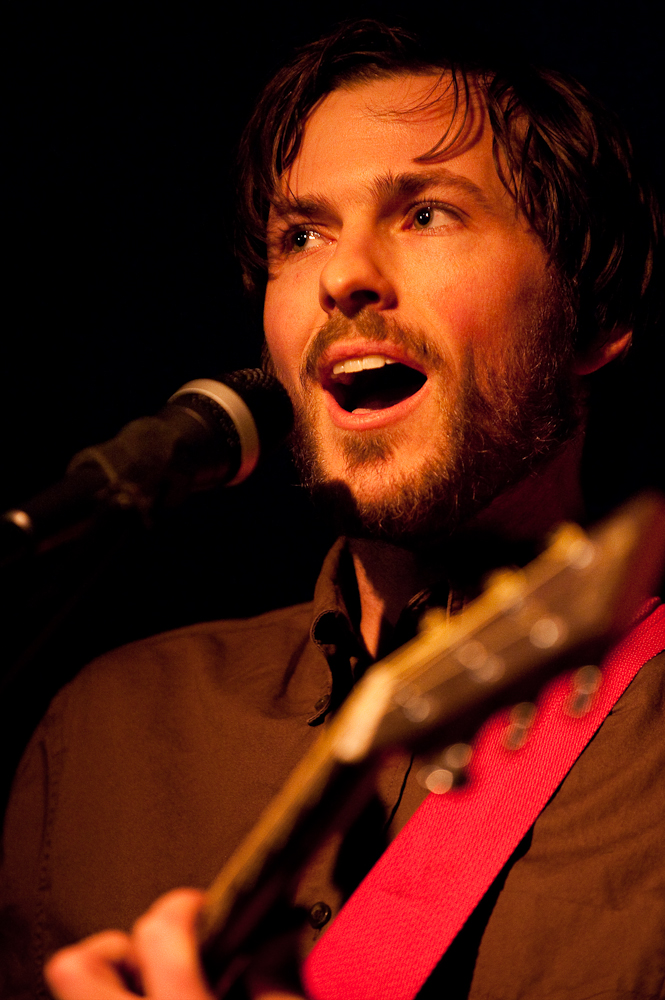
Some songs are just collections of catchy hooks and clever rhymes. And then there are songs that feel like stepping into a whole other consciousness—a world that is strange, unsettling, and profoundly resonant. “Fish Sticks,” a standout track from The Heligoats’ album Goodness Gracious, is firmly in the latter category. It’s a lyrical labyrinth that uses a dense web of aquatic metaphors to explore alienation, trauma, and the feeling of being trapped inside one’s own mind.
The brainchild of songwriter Chris Otepka, The Heligoats has long been a vehicle for intricate, surrealist narratives that reward repeat listening. “Fish Sticks” might be the ultimate example of his craft. To truly understand it, we need to dive beneath the surface.
Two Paths, One Source
At the heart of the song lies a single, brutal contrast that defines two completely different lives:
You were baptized in a river / I was thrown off a bridge
This isn’t just a clever line; it’s the song’s anchor. One path begins with a gentle, supported, spiritual entry into the world. The other begins with violence, rejection, and unsupported chaos. From this single point of divergence, two lives unfurl in stark opposition. While the “you” of the song finds their “inner self,” the speaker finds their “inner fish”—a devolved, primal, and mute version of a soul. While one has kids, the other has seizures. The song makes it clear: this initial trauma isn’t just a memory; it’s a permanent lens through which the speaker experiences the world.
The Agony of the Fishbowl
Have you ever felt alone in a crowded room? Otepka takes that feeling to a whole new level with the song’s central image: a “fishbowl on the beach.”
The speaker is trapped, able to see the vast ocean of genuine experience and connection but fundamentally unable to reach it. It’s a gut-wrenching metaphor for intellectual and emotional isolation. This isn’t a peaceful solitude; the “salty water stings,” a constant reminder of the discomfort of this confined existence. The alienation is so complete that even nature itself seems to reject the speaker, with the fish in the lake scoffing and wondering what they’re doing there.
In a moment of surreal desperation, the speaker’s solution is to simply check out. They
“just open up my mouth and let my mind jump off.”
It’s not a physical act, but an act of willed dissociation—a mental and emotional break from a reality that has become unbearable.
The Absurdity of Starting Over
The song takes a bizarre turn into a swamp where a sign declares,
“destruct, it’s fucked it’s done it’s just mud.”
This nihilistic impulse gives way to a pointless, godlike act of creation: building new huts, blinding new ducks, and giving them new titles. It’s a cutting critique of societal systems—the endless, meaningless cycle of tearing things down just to rebuild them with new, arbitrary rules and hierarchies.
This critique of “progress” is also personal. The speaker laments that the “you” in the song
“missed the songs you sang / Before you learned anything,”
suggesting that knowledge and technique have stripped away a more authentic, intuitive form of expression.
A Chilling Invitation
The song’s conclusion is its most haunting part. The speaker, now “swimming in a trough” like an animal, sees the other person finally step into the water. For a fleeting moment, you think this might be a reunion, a moment of redemptive empathy.
But the speaker’s perspective twists it into something sinister. For them,
“every edge of the lake is a fifty foot cliff,”
and once you’re in,
“there’s no way out of this.”
The final plea to
“turn back into amphibians”
and
“tread until our legs give in”
is not a hopeful call for a fresh start. It is an invitation to devolve, to give up the exhausting struggle of consciousness and simply exist until the end. It’s a shared descent, transforming the speaker’s private fishbowl into a collective, inescapable abyss. The desire to “start over” is a yearning for an end.
“Fish Sticks” is more than a song; it’s a complex, challenging, and ultimately heartbreaking piece of art. It reminds us that our formative experiences shape us in ways we can’t always control, and that sometimes, the most honest expression of pain is a retreat into the beautiful, terrifying wilderness of the imagination.
Support The Heligoats
Find Chris on tour
Buy Music and Merch Direct
Stream Songs on Spotify
Watch and Subscribe to the YouTube
 Broken Prism Studios